

MISSION OVERVIEW
The 1gSpace mission architecture is organized as a staged interstellar program targeting the Proxima Centauri system, with each vehicle assigned a defined validation, logistics, or settlement function within a single operational sequence.
The initial phase is centered on ACEP, an autonomous reconnaissance and technology-demonstration platform designed to validate continuous-acceleration flight, high-latency mission autonomy, long-duration subsystem stability, and scientific operations under interstellar conditions.
After arrival, ACEP establishes the first system-level dataset for Proxima b, including orbital dynamics, atmospheric behavior, surface morphology, thermal distribution, radiation environment, magnetic-field conditions, and candidate twilight-zone operating regions.
This information constrains risk for all later mission stages. ISV Innes then expands the assessment through crew-directed orbital survey and lander-based surface validation. ISV Anglada follows as the uncrewed logistics carrier, and ISV Proxima is reserved for the downstream population-transfer phase after the site and infrastructure model have been verified.
1G CONSTANT ACCELERATION
The 1 g transfer model represents an idealized symmetric acceleration and deceleration profile using sustained proper acceleration. In this reference case, the vehicle accelerates for the first half of the trajectory, performs an inertial reorientation maneuver, and then decelerates along the remaining half of the transfer arc.
The calculator illustrates the relativistic relationship between ship proper time, Earth-frame elapsed time, distance, and peak velocity. As distance increases, time dilation becomes operationally significant: elapsed time aboard the vehicle diverges from the external reference frame while the vehicle remains below c.
This model is a kinematic reference only. It does not include propulsion duty-cycle limits, fuel-margin constraints, interstellar medium interaction, relativistic debris exposure, accumulated radiation dose, navigation uncertainty, gravitational perturbations, thermal-management limits, or cosmological-scale effects at extreme distances.
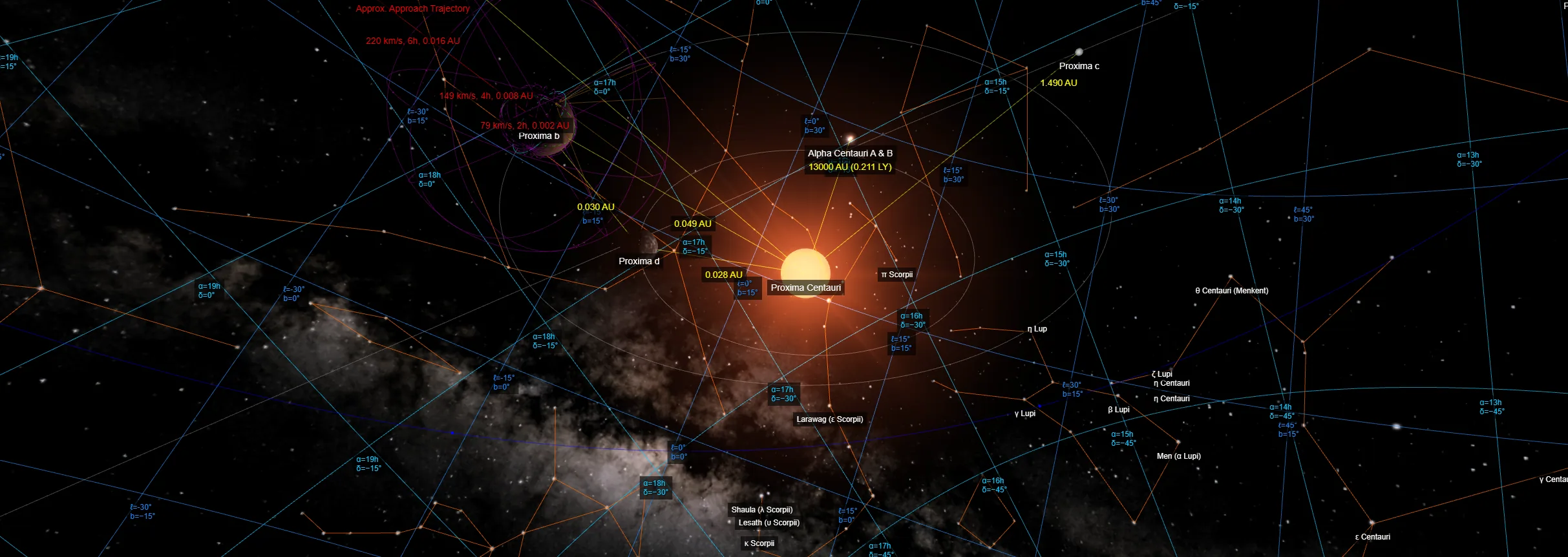
PROXIMA-CENTRED VISIBLE STARFIELD
The 1gSpace Proxima-Centred Visible Starfield reconstructs the catalogued stellar sky for an observer represented by the Proxima Centauri system barycentre proxy at epoch J2028.5270. Unlike conventional Earth-centred star maps, the catalogue foreground is transformed to the apparent positions, visual magnitudes, relative fluxes, and colours produced by that observer change.
The reconstruction contains 1,491,263 unique catalogue sources selected to Proxima apparent V ≤ 11.5. These stars form the astrometrically meaningful foreground, while a fixed NASA Deep Star Maps 2020 layer is retained as distant Milky Way context.
Public products concentrate on full-sky ICRS and Galactic maps prepared at resolutions up to 32K for visualization, spherical mapping, and high-resolution publication use.
Explore Starfield ProductsINITIAL HUMAN PRESENCE
The first human-operated stage is assigned to ISV Innes, which establishes the crew-rated validation phase of the Proxima Centauri mission architecture.
ISV Innes is intended to place a small specialized crew in the target system for orbital survey, environmental verification, and controlled lander-based assessment of candidate operating zones on Proxima b. This phase confirms terrain access, descent and ascent margins, local hazards, surface handling procedures, and crew-support assumptions under actual planetary conditions.
The primary candidate for early surface activity is Eternal Sunset. Before any permanent infrastructure is committed, the site is planned to be assessed first by ACEP from orbit, then by the ISV Innes crew through orbital observation, landing-site inspection, sample return or local analysis, and repeated surface-access cycles.
After crewed validation, ISV Anglada provides the uncrewed logistics stage. Its role is to deliver the equipment, consumables, construction assets, power systems, autonomous support hardware, and surface infrastructure required to transition Eternal Sunset from a validated site into an externally supported operational base.
LONG-DURATION SETTLEMENT
The long-duration settlement phase begins only after the reconnaissance, crewed validation, and uncrewed logistics stages have reduced the major environmental and operational uncertainties associated with Proxima b surface operations.
ISV Proxima is defined as the downstream population-transfer vehicle, responsible for transporting the larger colony element and the primary habitat systems required for permanent settlement. Its role depends on prior validation by ACEP, ISV Innes, and ISV Anglada, rather than operating as an isolated first-arrival vehicle.
Eternal Sunset is the supported initial settlement node. It is planned around transported habitats, delivered infrastructure, external logistics capacity, and pre-positioned surface systems, allowing the first permanent population to stabilize operations and develop reliable local workflows.
Eternal Sunrise represents the later self-derived expansion stage. Unlike Eternal Sunset, it is not planned around additional interstellar transport or external construction support. Its development must depend on in-situ materials, local manufacturing, mature resource extraction, established work practices, population structure, technical culture, governance norms, and operational methods developed on Proxima b itself.
In program terms, the mission sequence advances from reconnaissance to validation, from validation to supported habitation, and from supported habitation to local expansion. The objective is not only arrival, but the creation of a repeatable engineering and social framework for sustained planetary operations.